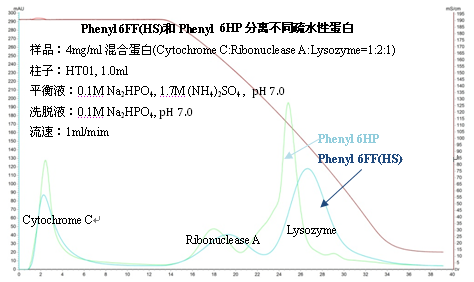
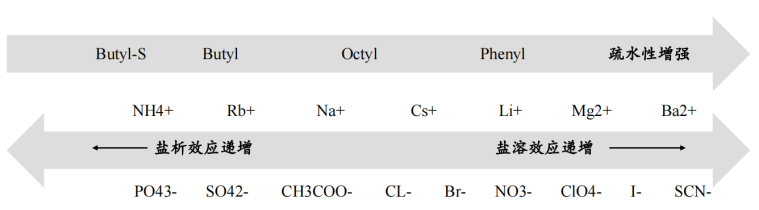
Hydrophobic chromatography separates proteins based on their differences in hydrophobicity, namely, through the reversible interaction between the hydrophobic groups on the surfaces of proteins and hydrophobic resin. Hydrophobic interaction is enhanced under high ionic strength conditions, so elution is typically achieved by reducing the ionic strength during binding in such environments. The unique adsorption and separation mode makes hydrophobic chromatography an ideal purification method after ammonium sulfate precipitation or high-salt elution in ion exchange.
Precautions for using hydrophobic chromatography resin:
● The hydrophobic interaction force varies with different ligands and ligand concentration resin.
● When different proteins are subjected to hydrophobic chromatography, or when different hydrophobic chromatography resin are used for purification, the salt concentration in the buffer solution varies.
● Temperature and pH have a significant impact on protein hydrophobicity, so pH and temperature should be kept constant during hydrophobic chromatography.
Product | Ligand concentration μmol/ml |
Particle size μm | Pressure MPa |
Flow Rate cm/h | pH
| Applications
|
Phenyl 6FF(LS) | 20 | 45-165 | ≤0.3 | 400 | 2-14(short) 3-13(long) | Separation and purification of various proteins, suitable for the purification of substances containing aromatic groups, with preference given to samples after salting out. |
Phenyl 6FF(HS) | 40 | 400 |
Phenyl 6HP | 25 | 25-45 | 150 |
Butyl-S 6FF | 10 | 45-165 | 400 |
2-14(short) 3-13(long) |
Butyl 4FF | 40 | 400 |
2-14(short) 3-13(long) |
Butyl 6HP | 50 | 25-45 | 150 |
2-14(short) 3-13(long) |
Butyl HPL | 20 | 45-165 | 400 |
2-14(short) 3-13(long) |
Octyl 4FF | 5 | 45-165 | 250 |
2-14(short) 3-13(long) |